Wondrous Travels
An Exact Account of Several Nations, Together with the Unsettled Space Between the Versions
Compiled for the Benefit of Such Travellers as Have Already Entered the Jurisdiction and Cannot Return. With Sixteen Companion Essays by the Cartographer.
No Traveller may remain here above one Paragraph without alteration.
Explore the atlas, essays, and reading guides freely. The complete novels open with a reading password.
Published for the Convenience of Such Persons as Prefer their Countries Stable; with Notes for Those Who Do Not.
First, a wife left an orange peel on a keyboard.
Nisha peeled the orange in one unbroken spiral and laid it across Lin’s keys like a small sun. There was cardamom on her fingers, a chipped mug beside the monitor, and the ordinary confidence of a wife who believed careful things could be kept. The travels begin when a system proves her wrong.
The atlas below follows five jurisdictions as they turn intimate life into prices, records, scores, testimony, and versions. Each offers a different kind of help. Each asks Lin to surrender something she may only later discover she needed.
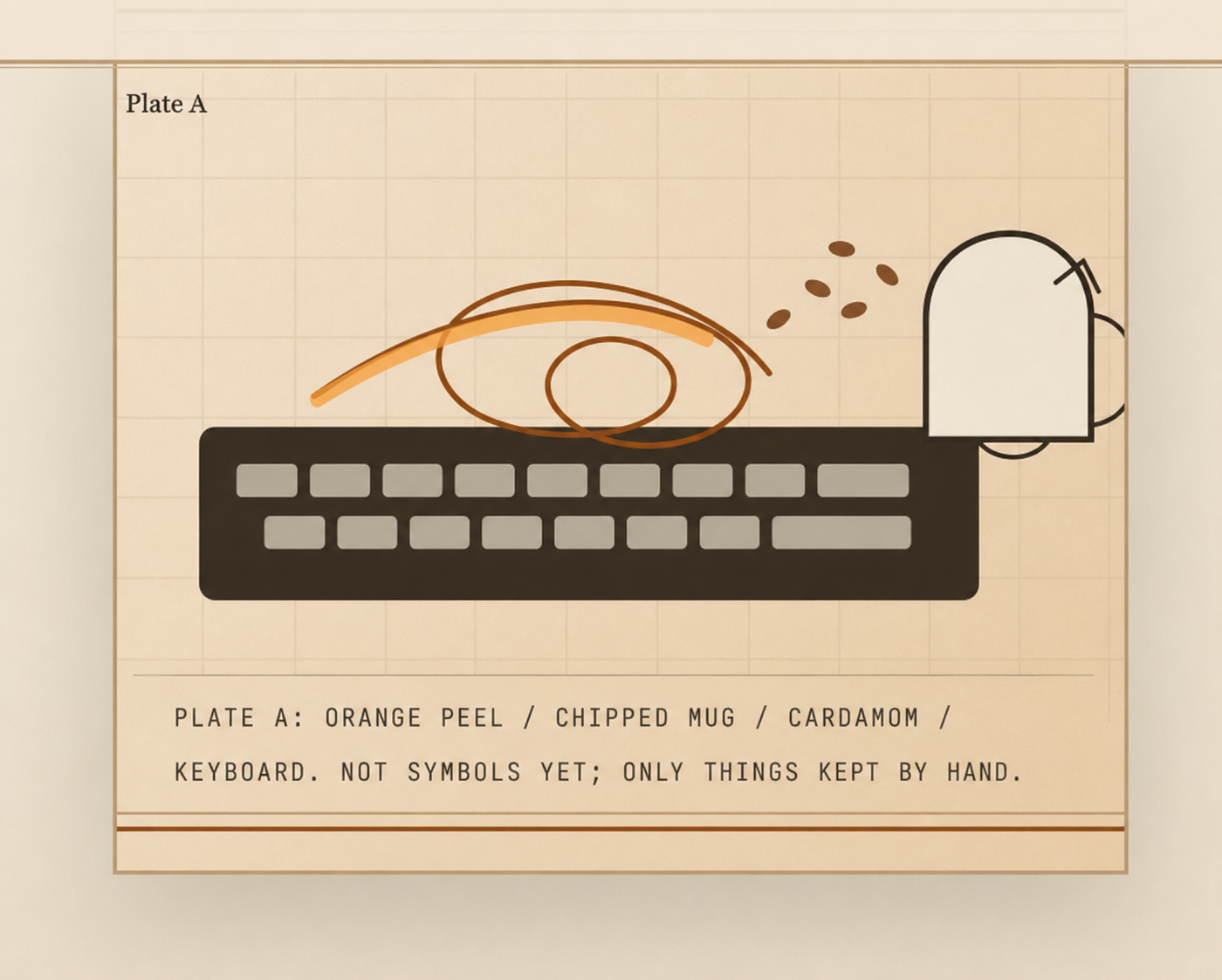
Plate A: Orange peel, chipped mug, cardamom, and keyboard. Not symbols yet; only things kept by hand.
Each nation promises to preserve Nisha more accurately. Lin must contend with the price of that promise—and with her own desire to decide which Nisha should return. Her wife’s wishes, refusals, and habits keep interrupting the account Lin wants to give of their marriage.
This site is an atlas of the jurisdictions. The novels are the journey. The apparatus may orient; it must not replace the orange peel, the mug, the hand, and the breath.
Liana Marie Sive · A connected body of work
The works in conversation
Grouped by form, each work offers an independent entrance. The manifesto connects them; their different forms can challenge its claims.
The intellectual manifesto
Understanding another person does not settle what I may do in her name.
Read the manifestoBiographyYou are here
Franz Marc
Maria’s criticism tests Franz’s philosophy; money, artistic labor, and edited letters reveal the conditions supporting his freedom and legacy.
Explore the workTwo independent novel cyclesYou are here
The Schattendorf Echoes
A household, a political movement, and competing narrators test whether another person’s answer can change shared action.
Explore the workSix-novel cycleYou are here
Wondrous Travels
The panopticon shapes Lin’s search for Nisha: watched by the Pi Council, she bargains with herself.
Explore the workBiblical and literary criticismYou are here
The Unnamed Daughter
Biblical criticism asks whose purposes disappear when sacred narratives assign people roles in someone else’s story.
Explore the workLiterary satireYou are here
Before Sive / After Sive
An academy rewards criticism of institutions, implicating the author’s pleasure in recognition and her ambition to found a school of thought.
Explore the workFeature screenplayYou are here
CASE 1638: RECALL
A mayor’s investigation of contaminated water tests public accountability and the difference between evidence and his own suspicions.
Explore the workFeature screenplay · CASE 1638You are here
The Cinematic Machine
As Sarah Chen investigates her father’s hidden work, the machinery turns its scrutiny upon her.
Explore the workStage playYou are here
Double or Nothing
A favorable ruling cannot automatically repair what an investigation has cost an academy and the people sustaining it.
Explore the workEach position marks a connection. The arrangement sets no ranking or reading order.
Lin Reyes seeks her wife, Nisha, across four nations and a repository that convert their marriage into price, record, score, testimony, and version. Surveillance shapes the choices she anticipates; offers of relief test her resistance; her own justifications can license the consequences she deplores. A queer/trans literary cycle in six completed volumes, combining institutional satire, intimacy, and musical and documentary forms.
The site is deliberately designed as a literary atlas, but the submission unit is one novel: Volume I, Compression Nation. The artwork is context, not required homework.
Note: the “witness” counter is an in-fiction device stored locally in your browser. No personal data is collected or transmitted. No analytics scripts run on this page.
Full Submission Details ▸
At a Glance
- Recommended Entry
- Volume I: Compression Nation. Continue through Volumes II–V. Read Volume 0 (The First Fault-Line) afterward to revisit the journey’s origins, or begin there if questions of origin and authorship draw you in.
- Rights
- World English & German translation rights available. Not previously published in book form. Full text accessible on this site.
- How to Read
- Chapters and materials for all six volumes are available below. Browse the table of contents. Choose your entry point. The work is the argument.
Why There Are Workbooks and Scholar’s Annexes
The apparatus matters most because the cycle distrusts apparatus. It may orient; it must not read on the reader’s behalf.
After the six operations, the danger is a seventh: explanation. A cycle whose antagonists price grief, record injury, score beauty, interpret hesitation, merge contradiction, and authenticate wounds cannot offer companions that merely perform those same operations on the novels. The workbooks and annexes exist to test whether explanation can refuse to become extraction.
Build no apparatus, and the cycle dodges its hardest test. Build the wrong apparatus, and the apparatus becomes the machine the novels indict. The substantial apparatus remains optional and selective, with limits on what it translates. The brief entry guide offers a starting route before reading.
Reader’s Apparatus
Substantial, optional companions with chapter commentary, questions, and reading routes for rereading and study. For a quick start, use the brief reading guide.
Workbook
A guided rereading and teaching path: prompts, dockets, pressure tests, open questions. It forms attention without pretending to finish the book.
Scholar’s Annex
The archive layer: primers, chapter dockets, German-term apparatus, problem sets, indices, and teaching files. Its coverage varies by volume; each guide identifies its scope. The teaching editions provide worked answers for selected exercises, not a claim to exhaust the novels.
Essays and Coda
Reception infrastructure: comparative frames, genre claims, recurring mechanics, and boundaries. They help critics, teachers, agents, and readers argue about the cycle without flattening it to a trick.
Some apparatus protects by refusing to explain. Nishasprache is not a code to break. 王 is not a glossary item. Some meanings are constituted by relation and die when made public. The apparatus may mark the boundary; it must not cross it for the reader.
Begin with the novel, or consult the brief reading guide for help choosing a route. Use the substantial companions, workbooks, and Scholar’s Annexes selectively for rereading, teaching, research, translation review, or sustained study.
Consult the Apparatus Archive Read On Apparatus: Six Prefaces Read Essay IX
The study materials linked here are in English, with German passages where relevant.
Open the Workbooks and Scholar’s Annexes
The apparatus archive is already included in this site. It lives in the apparatus/ folder. These links open the actual companion files, workbooks, and scholar annexes directly.
Recommended use: read the novel first; use these files after reading, for rereading, teaching, or sustained study.
A Survey of the Territories
The atlas begins with a domestic object: an orange peel, a chipped mug, a wife’s hand in the dark. Everything below is a map of what systems do to that kind of relation when they call processing care. The system is helpful. It offers context cards, stability indices, and gentle prompts. It calls enforcement atmosphere and extraction support. Wondrous Travels is six volumes that govern the reader through the same mechanisms the volumes describe: compression, magnification, abstraction, optimization, and the quiet violence of being offered a choice that has already been logged. The apparatus is not the subject. The apparatus is the prose. Lin Reyes moves through four impossible nations and a repository searching for her wife, Nisha—scattered across jurisdictions as fragments the bureaucracy cannot fully classify—and warmth, citrus, and a mispronunciation that means home survive beyond the system’s files.
Volume 0, The First Fault-Line, is the recursion anchor—the origin myth that reveals the system’s architecture: contradiction governance, the authentication economy, bilingual epistemology, and the reader as “Third Author.” Read it before Volume I for the origins of the journey, or after Volume V to encounter the architecture retrospectively. The architecture is more powerful when discovered than when explained in advance.
The five volumes of Wondrous Travels proper follow Swift’s four-voyage structure (expanded to five), with each jurisdiction corresponding to a Swiftian satirical target updated for the twenty-first century and each governed by one of five Faustian iterations that trace the history of the devil’s bargain from Marlowe through Goethe through Mann to the present.
Swift (1726)
Four impossible nations. Lilliput (miniaturized tyranny), Brobdingnag (magnified scrutiny), Laputa (abstraction divorced from reality), Houyhnhnms (reason without humanity). Gulliver returns home but cannot reintegrate. The satire has no remedy.
Liana Marie Sive
Four impossible nations—Compression, Magnification, Abstract, and Rational—lead into the repository of Between the Versions. Their different procedures expose Lin and the reader to competing claims of authority.
The Five-Nation Mapping
The Faustian Bargain and the Grand Inquisitor
The Faust labels in the table are not outside homework. They are internal coordinates for how the bargain changes across the cycle. Faust names the form of the exchange; the Grand Inquisitor names the authority that makes the exchange feel merciful.
Faust
In this cycle, Faust does not mean that each volume retells the same story. It names the evolving bargain: from an explicit contract, to experience, to beauty and world-making, to artistic witness, and finally to the reader’s own desire for coherence.
Grand Inquisitor
The Grand Inquisitor line runs through Dostoevsky: the terrifying argument that people will surrender freedom for bread, miracle, and authority. Wondrous Travels multiplies that figure into institutional Inquisitors, each offering relief exactly where Lin, and the reader, are most exhausted.
The following reference table is in English; the bilingual summaries above introduce its literary comparisons.
| Iteration | Source-pressure, explained in house | Cycle operation | Inquisitor form |
|---|---|---|---|
| Faust 1.0 | Marlowe: the bargain as visible contract — knowledge, power, relief, and a named counterparty. | Compression: reduction offers relief at the price of what cannot fit. | The Market-Inquisitor offers bread as optimized simplicity. |
| Faust 2.0 | Goethe I: the bargain becomes experience, striving, satisfaction, and human cost. | Magnification: experience is recorded, amortized, and charged. | The Ledger-Inquisitor offers authority through total record. |
| Faust 3.0 | Goethe II: the bargain expands into beauty, form, statecraft, and world-making. | Abstract: beauty and pattern become a jurisdiction. | The Silent-Inquisitor offers miracle as form, score, and worship. |
| Faust 4.0 | Mann: the bargain enters art, illness, witness, interpretation, and historical catastrophe. | Rational: the reader’s witness becomes the apparatus of interpretation. | The Reader-Inquisitor offers authority as helpful context. |
| Faust 5.0 | Sive: the bargain no longer needs a devil. The self, the interface, the archive, and the reader’s desire for coherence can perform the contract. | Between the Versions: coherence itself becomes the offer. | The final Inquisitor offers merger: relief from contradiction at the cost of relation. |
These links stay inside the atlas. They are handrails, not outside authorities: click them to return here, then go back to the novels.
The 1–6–3–8 Book Architecture
Volumes 0 and II explicitly develop the 1–6–3–8 arrangement: one Prime Book, six Branch Books, three Reconciliation Books, and eight Off-Balance Books. These eighteen books organize the fictional institution’s accounting; they do not provide a chapter count for every novel.
The other volumes use different formal arrangements, including Volume III’s Tone, Canon, and HÖRPROTOKOLL triads and Volume V’s repository branches and endings. The recurring numbers connect these arrangements without making them identical.
The Rotation: Each Relief Becomes the Next Capture
| Volume | Promised Relief | What Is Extracted | Reader Position |
|---|---|---|---|
| I | Efficiency as mercy | Meaning (compressed to fit) | Consumer (threads accumulate) |
| II | Completeness as justice | Experience itself | Co-signer (witness produces stability) |
| III | Beauty as transcendence | Form / pattern | Congregant (misreading as worship) |
| IV | Transparency as democracy | Witness | Conscript (you are Witness-Field) |
| V | Choice as freedom | Choice itself | Variable (authentication is your task) |
A six-volume dystopian satire that makes the reader a structural variable in the work itself. Your attention is already being measured. Your witness is already being priced.
Total access is a form of violence. Withholding can be an ethics. Some meanings in these novels will remain inaccessible on principle—not because the author failed to create them but because creating them fully would destroy the quality that makes them worth protecting.
Charts of the Several Nations & Their Jurisdictions
Chapter titles follow the language and wording of the manuscripts.
A Literary Critical Companion in Sixteen Chapters
Begin with Chapter I for the reader’s changing position within the fiction; Chapter V for the bargain Lin makes with herself under observation; and Chapter VIII for Nisha’s wishes, privacy, and the limits of rescue. The other essays develop the formal, historical, and economic conditions of those problems.
These sixteen chapters form a literary criticism book by the author of Wondrous Travels. They develop arguments about the voyage, the marriage, institutional authority, and the forms through which the reader encounters them. The novels remain primary; the essays propose readings to test, not conclusions a reader must accept. They discuss events across all six volumes.
Select the volumes you have read to see recommended essays. All essays remain accessible, including those that discuss later events.
Recommended After Traversal (Curator’s Shelf)
The sixteen companion essays
The Machine That Fails
Jurisdiction, Real Help, Reader Capture,
and the Unannotatable Remainder
A coda by L.M.S. — not Article XVII and not Volume VI, but the seventeenth term: the synthetic document that arrives only after the six volumes and sixteen companion articles have done their work. It names the apparatus, maps the jurisdictions, and warns the sophisticated reader against the beautiful wrong move of completing the machine.
A brief reflection to read after Essays I–XVI. Return to the novels when its questions lead you back to a scene.
On the Philosophical Terrain
Criticism and its uses
The novels ask what happens when an institution can use an accurate criticism. Recognition may change conduct, furnish another service, or help Lin defend her own choices. Its effect must be judged in the scene.
Exposure and participation
Showing the apparatus gives the reader something to judge. It does not guarantee withdrawal from it. Forms, prompts, and commentary can solicit the very participation they make visible.
The traveler’s authority
The cycle joins Swift’s contested travel accounts to jurisdictions that claim the traveler’s speech, attention, and reasons. Neither the narrator nor the reader receives a position of automatic innocence.
Two languages in conflict
English and German organize different pressures, but neither language has a fixed moral role. The analytical voice may preserve a distinction and also make continued participation easier. Translation must attend to these functions.
The bargain with oneself
Lin can recognize an offer’s danger and still give herself a reason to accept or postpone refusal. The fourth Faustian inversion takes place under observation: the Council acts on decisions without needing complete knowledge of their motives.
Relief and authority
The Inquisitors offer benefits that can work. Their danger lies in the authority attached to relief and in their competing claims over its recipient. A useful service does not establish a right to govern a life.
A person beyond the rescue
Nisha’s returned presences do not simply answer Lin’s need. Her wishes, privacy, and unshared life test the claim that preserving someone is necessarily an act performed for them.
Judgment without a guarantee
Interruptions and refusals have particular consequences. A system may learn from them, charge for them, or fail temporarily. The novels keep those differences open to judgment instead of making every remainder a victory.
The Vocabulary of the Voyage
Nishasprache
Meaning arises in a relation, not in a codebook Lin or the reader can own. That relation can be threatened, imitated, or indexed. Nisha’s privacy also includes a life Lin does not share.
王 and the demand for authorization
The same mark meets different institutions. One screen bills it; another has trouble rendering it; a later system reads it and demands an authorized signatory. Its force depends on what people and institutions do around it.
The Experience Meter
Extraction reaches beyond information into a person’s capacity for experience. The economic question becomes intimate: what happens to love, attention, and the ability to be changed when they support a repayment schedule?
Witness-Field and witness
The witness field draws the reader into the work’s forms of participation. Giving testimony, being recorded, and authorizing an account are different acts. The novels test how institutions try to collapse them.
The Inquisitors’ competing claims
Amortization and liquidation offer different ways to claim the same person. Later, competing claims and bills make the QMD economy consume its own basis. Their conflict can open a seam without making any claimant a liberator.
Interruption and its aftermath
Lin’s broken syntax and bodily interruptions can obstruct a procedure. Their duration and aftermath matter: a pause is not an escape, and a system may learn to extract value from nonclosure.
Schattendorf and Wondrous: knowledge, permission, and the panopticon
A narrator may know a person’s thoughts. A political movement may speak for her interests. A system may predict her next decision. None of those capacities settles its authority to choose for her. The Schattendorf Echoes and Wondrous Travels make the struggle over that authority part of their stories and their forms.
Schattendorf follows that struggle through shared rooms, artistic work, political commitments, and the Austrian crises of 1927 and 1934. Julia’s writing acquires readers whose responses she cannot control. Hermann discovers the limits of an office she hoped to use. In the independent English cycle, Lord Alistair’s privileged knowledge entangles the narrator in the authority he describes. The German cycle and his English rendering offer independent accounts; the latter does not translate the former.
Wondrous brings observation, classification, and self-justification into Lin and Nisha’s marriage. The Pi Council can shape conduct through anticipated judgment; it need not see everything. QMD’s fictional prices, allocations, and guarantees put relationships under pressure. The Inquisitors offer relief with reasons a tired person might accept. Lin’s bargain with herself can preserve an accurate account of her objections while allowing harmful consequences to continue.
Both projects give intimacy, humor, and formal experiment a place in this inquiry. They also put the manifesto under pressure: a principle must survive an encounter with another person’s purposes. Readers enter through different lives, and neither project supplies a final vantage point from which everyone else can be understood and governed.
The Franz Marc biography tests related claims against letters, material support, and editorial decisions: Maria’s objection matters through the changes it demands, not merely its preservation. The Unnamed Daughter asks whose purposes sacred narratives sacrifice or leave unnamed, while attending to dissent within those traditions. Both sharpen the question of Nisha’s independent purposes.
The films and plays make evidence face an audience and a deadline. Recall tests Gil’s public case against his obligations to people he has hurt. In The Cinematic Machine, an archive begins investigating Sarah Chen herself. In Double or Nothing, a favorable ruling may arrive too late for the academy it concerns. These encounters give Wondrous’s records, surveillance, and delayed decisions distinct counterparts.
Correspondence
Queries from agents, editors, and translators welcome. Rights documentation and translation briefs available on request. Calais, Maine phone.
After the Novel: Companions, Workbooks, Scholar Archives
The brief reading guide can help you choose an entrance. Use the substantial companion, workbook, or scholar archive selectively during rereading and study. See Why There Are Workbooks and Scholar’s Annexes for the governing principle.
Reader’s Apparatus
Substantial optional guides for rereading and study; consult selected sections.
Workbook
Guided rereading, prompts, dockets, and teaching structure.
Scholar’s Annex
Optional archive for research, citation, seminars, and sustained study.
Six Prefaces
The governing note on why explanation must not become the seventh nation.
Consult the Apparatus Archive Read On Apparatus
The apparatus now distinguishes chapter guides, focused scholar exercises, and rebuilt teacher answers. Each edition states its coverage and links its answers to passages in the novels.