Wondrous Travels
An Exact Account of Several Nations, Together with the Unsettled Space Between the Versions
Compiled for the Benefit of Such Travellers as Have Already Entered the Jurisdiction and Cannot Return. With Sixteen Navigation Charts by the Cartographer.
No Traveller may remain here above one Paragraph without alteration.
Published for the Convenience of Such Persons as Prefer their Countries Stable; with Notes for Those Who Do Not.
First, a wife left an orange peel on a keyboard.
Nisha peeled the orange in one unbroken spiral and laid it across Lin’s keys like a small sun. There was cardamom on her fingers, a chipped mug beside the monitor, and the ordinary confidence of a wife who believed careful things could be kept. The travels begin when a system proves her wrong.
The atlas below is what happens to that moment when five jurisdictions try to stabilize it: first as price, then as record, then as score, then as witness, then as merge. The machinery is elaborate because the antagonist is elaborate. The wound is simple.
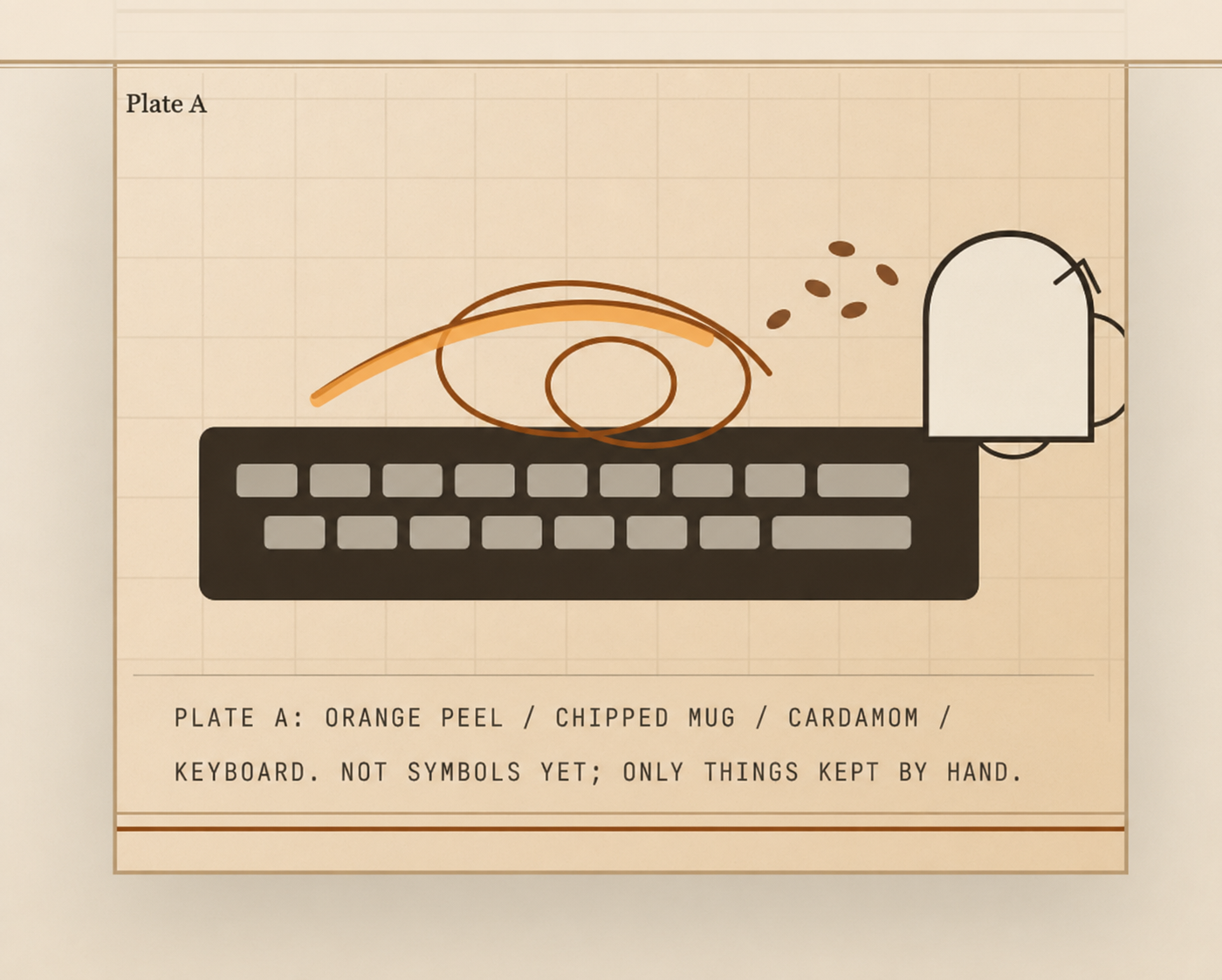
Plate A: Orange peel, chipped mug, cardamom, and keyboard. Not symbols yet; only things kept by hand.
Each nation claims to preserve Nisha more accurately: as price, as record, as score, as witness, as version. Each preservation damages the relation it claims to protect. Lin is not looking for a better term for her wife. She is looking for what remains of a marriage when recognition becomes processing.
This site is an atlas of the jurisdictions. The novels are the journey. The apparatus may orient; it must not replace the orange peel, the mug, the hand, and the breath.
The love story is simple: Lin Reyes is trying to recover her wife, Nisha. The antagonist is procedural: five island-jurisdictions and one fault-line convert that marriage into price, record, score, witness, and version. A formally constrained queer/trans literary cycle in six volumes.
The site is deliberately designed as a literary atlas, but the submission unit is one novel: Volume I, Compression Nation. The artwork is context, not required homework.
Note: the “witness” counter is an in-fiction device stored locally in your browser. No personal data is collected or transmitted. No analytics scripts run on this page.
Full Submission Details ▸
At a Glance
- Recommended Entry
- Volume I: Compression Nation. Begin with Lin’s journey. Volume 0 (The First Fault-Line) is the recursion anchor—available after the five nations have been traversed (postlude, not prologue).
- Rights
- World English & German translation available. Not previously published. Full text accessible on this site.
- How to Read
- Chapters and materials for all six volumes are available below. Browse the table of contents. Choose your entry point. The work is the argument.
Why There Are Workbooks and Scholar’s Annexes
The apparatus matters most because the cycle distrusts apparatus. It may orient; it must not read on the reader’s behalf.
After the six operations, the danger is a seventh: explanation. A cycle whose antagonists price grief, record injury, score beauty, interpret hesitation, merge contradiction, and authenticate wounds cannot offer companions that merely perform those same operations on the novels. The workbooks and annexes exist to test whether explanation can refuse to become extraction.
Build no apparatus, and the cycle dodges its hardest test. Build the wrong apparatus, and the apparatus becomes the machine the novels indict. The right apparatus is optional, off the first path, selective, and disciplined about what it will not translate.
Reader’s Apparatus
A short threshold: orientation, permissions, voices, load-bearing chapters. It helps a reader begin again after the novel without making anyone feel unqualified to begin the voyage.
Workbook
A guided rereading and teaching path: prompts, dockets, pressure tests, open questions. It forms attention without pretending to finish the book.
Scholar’s Annex
The archive layer: primers, chapter dockets, German-term apparatus, problem sets, indices, and teaching files. It is total coverage only for readers who have chosen study after encounter.
Charts and Coda
Reception infrastructure: comparative frames, genre claims, recurring mechanics, and boundaries. They help critics, teachers, agents, and readers argue about the cycle without flattening it to a trick.
Some apparatus protects by refusing to explain. Nishasprache is not a code to break. 王 is not a glossary item. Some meanings are constituted by relation and die when made public. The apparatus may mark the boundary; it must not cross it for the reader.
Recommended path: read the novel first; consult the Reader’s Apparatus only afterward; use workbooks and Scholar’s Annexes for rereading, teaching, research, translation review, or sustained study.
Consult the Apparatus Archive Read On Apparatus: Six Prefaces Read Article IX
Open the Workbooks and Scholar’s Annexes
The apparatus archive is already included in this site. It lives in the apparatus/ folder. These links open the actual companion files, workbooks, and scholar annexes directly.
Recommended use: read the novel first; use these files after reading, for rereading, teaching, or sustained study.
A Survey of the Territories
The atlas begins with a domestic object: an orange peel, a chipped mug, a wife’s hand in the dark. Everything below is a map of what systems do to that kind of relation when they call processing care. The system is helpful. It offers context cards, stability indices, and gentle prompts. It calls enforcement atmosphere and extraction support. Wondrous Travels is six volumes that govern the reader through the same mechanisms the volumes describe: compression, magnification, abstraction, optimization, and the quiet violence of being offered a choice that has already been logged. The apparatus is not the subject. The apparatus is the prose. Lin Reyes moves through five impossible nations searching for her wife, Nisha—scattered across jurisdictions as fragments the bureaucracy cannot fully classify—and what survives is not what the system files but what it fails to hold: warmth, citrus, a mispronunciation that means home.
Volume 0, The First Fault-Line, is the recursion anchor—the origin myth that reveals the system’s architecture: contradiction governance, the authentication economy, bilingual epistemology, and the reader as “Third Author.” It publishes after the five-nation journey is complete. The architecture is more powerful when discovered than when explained in advance.
The five volumes of Wondrous Travels proper follow Swift’s four-voyage structure (expanded to five), with each nation corresponding to a Swiftian satirical target updated for the twenty-first century and each governed by one of five Faustian iterations that trace the history of the devil’s bargain from Marlowe through Goethe through Mann to the present.
Swift (1726)
Four impossible nations. Lilliput (miniaturized tyranny), Brobdingnag (magnified scrutiny), Laputa (abstraction divorced from reality), Houyhnhnms (reason without humanity). Gulliver returns home but cannot reintegrate. The satire has no remedy.
Sive (2025–)
Five impossible nations. Compression (data reduction), Magnification (total surveillance), Abstract (model supremacy), Rational (optimization), Between the Versions (recursive collapse). Lin cannot return because there is no outside. The satire makes the reader the final inquisitor.
The Five-Nation Mapping
The Faustian Bargain and the Grand Inquisitor
The Faust labels in the table are not outside homework. They are internal coordinates for how the bargain changes across the cycle. Faust names the form of the exchange; the Grand Inquisitor names the authority that makes the exchange feel merciful.
Faust
In this cycle, Faust does not mean that each volume retells the same story. It names the evolving bargain: from an explicit contract, to experience, to beauty and world-making, to artistic witness, and finally to the reader’s own desire for coherence.
Grand Inquisitor
The Grand Inquisitor line runs through Dostoevsky: the terrifying argument that people will surrender freedom for bread, miracle, and authority. Wondrous Travels multiplies that figure into institutional Inquisitors, each offering relief exactly where Lin, and the reader, are most exhausted.
| Iteration | Source-pressure, explained in house | Cycle operation | Inquisitor form |
|---|---|---|---|
| Faust 1.0 | Marlowe: the bargain as visible contract — knowledge, power, relief, and a named counterparty. | Compression: reduction offers relief at the price of what cannot fit. | The Market-Inquisitor offers bread as optimized simplicity. |
| Faust 2.0 | Goethe I: the bargain becomes experience, striving, satisfaction, and human cost. | Magnification: experience is recorded, amortized, and charged. | The Ledger-Inquisitor offers authority through total record. |
| Faust 3.0 | Goethe II: the bargain expands into beauty, form, statecraft, and world-making. | Abstract: beauty and pattern become a jurisdiction. | The Silent-Inquisitor offers miracle as form, score, and worship. |
| Faust 4.0 | Mann: the bargain enters art, illness, witness, interpretation, and historical catastrophe. | Rational: the reader’s witness becomes the apparatus of interpretation. | The Reader-Inquisitor offers authority as helpful context. |
| Faust 5.0 | Sive: the bargain no longer needs a devil. The self, the interface, the archive, and the reader’s desire for coherence can perform the contract. | Between the Versions: coherence itself becomes the offer. | The final Inquisitor offers merger: relief from contradiction at the cost of relation. |
These links stay inside the atlas. They are handrails, not outside authorities: click them to return here, then go back to the novels.
The 1–6–3–8 Book Architecture
Each volume is internally organized by a recursive Book structure that operates like a heartbeat: 1 Prime Book (the baseline jurisdiction), 6 Branch Books (taxonomies of institutional violence), 3 Reconciliation Books (forced narrative closures), and 8 Off-Balance Books (shadow zones where category errors are buried with reverence). The rhythm 1–6–3–8 appears throughout as timestamps, filing codes, measure numbers—the system’s pulse that Cardinal Kung’s witness alone refuses to match.
The Rotation: Each Relief Becomes the Next Capture
| Volume | Promised Relief | What Is Extracted | Reader Position |
|---|---|---|---|
| I | Efficiency as mercy | Meaning (compressed to fit) | Consumer (threads accumulate) |
| II | Completeness as justice | Experience itself | Co-signer (witness produces stability) |
| III | Beauty as transcendence | Form / pattern | Congregant (misreading as worship) |
| IV | Transparency as democracy | Witness | Conscript (you are Field 14) |
| V | Choice as freedom | Choice itself | Variable (authentication is your task) |
A six-volume dystopian satire that makes the reader a structural variable in the work itself. Your attention is already being measured. Your witness is already being priced.
Total access is a form of violence. Withholding can be an ethics. Some meanings in these novels will remain inaccessible on principle—not because the author failed to create them but because creating them fully would destroy the quality that makes them worth protecting.
Charts of the Several Nations & Their Jurisdictions
Sixteen Critical Articles
Start with Article I (You Enter the Jurisdiction) — how the reader’s position shifts from subject to participant. Then Article III (Five Inquisitors) — the governance architecture across all six volumes. Then Article VIII (The Warm Lie) — Nisha distributed across six volumes; the emotional core.
The following articles constitute a critical companion to the series—sixteen analyses written by the author to make explicit the formal, philosophical, and political commitments that govern each volume. They are jurisdictional. Read them too early and they will name mechanisms before the novels can make you live them. Declare your traversal below; the atlas will warn when a chart runs ahead of your position.
Declare which volumes you have traversed. The atlas will recommend charts at your position. Reading ahead is permitted; it will be logged as PREEMPTIVE.
Recommended After Traversal
(Curator’s Shelf)
Complete Critical Companion
The Machine That Fails
Jurisdiction, Real Help, Reader Capture,
and the Unannotatable Remainder
A coda by L.M.S. — not Article XVII and not Volume VI, but the seventeenth term: the synthetic document that arrives only after the six volumes and sixteen companion articles have done their work. It names the apparatus, maps the jurisdictions, and warns the sophisticated reader against the beautiful wrong move of completing the machine.
Recommended after Articles I–XVI. The treatise is dangerous if read first; it pre-teaches the trap.
On the Philosophical Terrain
The Adorno Problem, Solved Through Form
Adorno showed that the culture industry can absorb critique and return it as product. Wondrous Travels literalizes that danger. In Volume II, careful analysis can become sedation; calm itself can be converted into extraction capacity. The cycle’s answer is not anti-intellectualism. It is a demand that thought remain answerable to the bodily and relational remainder it cannot process.
The Brechtian Apparatus That Metabolizes Its Own Exposure
Brecht trusted exposure: show the apparatus, and the audience may recognize the machinery. The Ledger has already read Brecht. It can bill recognition, monetize distance, and turn comprehension into yield. The cycle’s alienation effects therefore become unstable: the reader may see the trap and still feed it by seeing.
Satire Without an Outside
Swift could send Gulliver away and bring him back. The later volumes of Wondrous Travels no longer permit that exterior. The satirical object is not safely elsewhere; it includes the interface, the archive, the market, the reader’s attention, and the wish for a clean interpretation. The reader does not interpret the system from outside. The reader operates it.
Bilingual Epistemology
The English/German architecture is not ornament. English often functions as the procedural surface: filing, compliance, interface, instruction. German carries delay, pressure, residue, phenomenological resistance, and sometimes comic counter-speech. Neither language is pure. Both can be captured. Meaning survives in the gap, not because the gap is mystical, but because no single administrative language can safely contain the relation.
The Distributed Beloved
Nisha is the emotional and philosophical center of the cycle: a person fragmented across jurisdictions that can recognize only what each jurisdiction is built to process. She appears as warmth, record, score, peripheral witness, branch, and version. Lin’s search is therefore not simply recovery. It is an ethical refusal to let the beloved become whatever form the system can most easily preserve.
The Reader as Constitutional Variable
By Volume IV, the reader is no longer an observer. Field 14, WITNESS, is the blank slot filled by reading. The cycle does not flatter the reader with power; it implicates the reader in completion. The more skillfully the reader interprets, the more the system can learn from that interpretation. Genuine witness must therefore resist becoming only usable attention.
Five Faustian Iterations
The Faust structure names the evolving form of the bargain. Marlowe makes the bargain explicit: knowledge for soul. Goethe transforms it into experience, striving, and beauty. Mann makes it a problem of art, witness, illness, and historical catastrophe. In Wondrous Travels, the bargain becomes procedural: no devil needs to appear because institutions, ledgers, interfaces, scores, and the desire for coherence can perform the devil’s work.
Authenticated Multiplicity as Resolution
The cycle refuses both synthesis and collapse. Its final pressure is authenticated multiplicity: holding incompatible truths without liquidating any of them into one clean account. This is not relativism and not an elegant escape. It is a burden. The versions remain true enough to matter and insufficient enough to hurt. HOME is queried as a field; the field will not accept a sentence.
The Adorno Problem, Solved Through Form
Adorno showed that the culture industry can absorb critique and return it as product. Wondrous Travels literalizes that danger. In Volume II, careful analysis can become sedation; calm itself can be converted into extraction capacity. The cycle’s answer is not anti-intellectualism. It is a demand that thought remain answerable to the bodily and relational remainder it cannot process.
The Brechtian Apparatus That Metabolizes Its Own Exposure
Brecht trusted exposure: show the apparatus, and the audience may recognize the machinery. The Ledger has already read Brecht. It can bill recognition, monetize distance, and turn comprehension into yield. The cycle’s alienation effects therefore become unstable: the reader may see the trap and still feed it by seeing.
Satire Without an Outside
Swift could send Gulliver away and bring him back. The later volumes of Wondrous Travels no longer permit that exterior. The satirical object is not safely elsewhere; it includes the interface, the archive, the market, the reader’s attention, and the wish for a clean interpretation. The reader does not interpret the system from outside. The reader operates it.
Bilingual Epistemology
The English/German architecture is not ornament. English often functions as the procedural surface: filing, compliance, interface, instruction. German carries delay, pressure, residue, phenomenological resistance, and sometimes comic counter-speech. Neither language is pure. Both can be captured. Meaning survives in the gap, not because the gap is mystical, but because no single administrative language can safely contain the relation.
The Distributed Beloved
Nisha is the emotional and philosophical center of the cycle: a person fragmented across jurisdictions that can recognize only what each jurisdiction is built to process. She appears as warmth, record, score, peripheral witness, branch, and version. Lin’s search is therefore not simply recovery. It is an ethical refusal to let the beloved become whatever form the system can most easily preserve.
The Reader as Constitutional Variable
By Volume IV, the reader is no longer an observer. Field 14, WITNESS, is the blank slot filled by reading. The cycle does not flatter the reader with power; it implicates the reader in completion. The more skillfully the reader interprets, the more the system can learn from that interpretation. Genuine witness must therefore resist becoming only usable attention.
Five Faustian Iterations
The Faust structure names the evolving form of the bargain. Marlowe makes the bargain explicit: knowledge for soul. Goethe transforms it into experience, striving, and beauty. Mann makes it a problem of art, witness, illness, and historical catastrophe. In Wondrous Travels, the bargain becomes procedural: no devil needs to appear because institutions, ledgers, interfaces, scores, and the desire for coherence can perform the devil’s work.
Authenticated Multiplicity as Resolution
The cycle refuses both synthesis and collapse. Its final pressure is authenticated multiplicity: holding incompatible truths without liquidating any of them into one clean account. This is not relativism and not an elegant escape. It is a burden. The versions remain true enough to matter and insufficient enough to hurt. HOME is queried as a field; the field will not accept a sentence.
The Vocabulary of Survival
王 Nishasprache
The language that survives by refusing to be shared. Nishasprache is not a constructed conlang but a relational event—meaning that exists only between Lin and Nisha, that collapses when made public. The text describes its effects (heat, breath, contact) without rendering its words, because rendering would be theft. If the reader can repeat it, it can be harvested. Nishasprache survives by being unrepeatable. It is the opposite of platform language.
王 The Unpriceable Remainder
The glyph 王 (king) appears throughout the series as physics, not symbol. It marks what cannot be priced, filed, or amortized—the remainder that persists when all administrative categories fail. In Volume II, it names the warm box Lin carries. In Volume III, it disrupts the twelve-tone row. In Volume IV, it crashes context tools. In Volume V, it is the only stable unit when the authentication economy eats itself. Cardinal Kung’s witness—“Long live Christ the King”—is the sentence that cannot be rephrased into safe synonyms, the unforgeable commit signature that authenticates without being priced.
王 The Experience Meter
The most precise critique of late-capitalist affect extraction. The Experience Meter doesn’t extract data or memory—it extracts the capacity to be changed. Joy, attention, the texture of wanting. Not surveillance as information-gathering, but surveillance as transformation-harvesting. To extract joy is to extract the quality of being present to one’s own life. Love becomes a repayment schedule. The bilingual structure performs complicity: you can comply or you can feel, but the system captures both.
王 Field 14
The blank slot: WITNESS. You fill it by reading. In Volume IV, Field 14 breaches—the witness layer spills into physical reality. Footnotes become objects. Comment threads hang like laundry. The text stops pretending you are outside. “WITNESS DETECTED. YOU ARE HERE.” The reader’s participation is the only thing the system cannot fully price, because genuine witness generates 0 TW—energy the market cannot capture. But witness that can be logged, annotated, or aggregated becomes fuel.
王 The Inquisitor War
The system is not one. The Ledger asks: What will you owe? The Market asks: What will you take? One wants amortization (slow extraction over time); the other wants liquidation (immediate settlement). They are not allies—they are competitors for the same asset. In Volume II, their conflict creates a jurisdictional seam: when both systems react simultaneously but cannot coordinate, voice slips through. Eli speaks again not because the system permits it but because the system stutters. The war between Inquisitors is not liberation. It is the only gap in which the unpriceable can move.
王 Sabotage as Grammar
Lin’s resistance is not heroic refusal. It is format failure. “Zwischen—Zins—between—Zahl—nicht—now—” The fused speech that neither system can parse. The Market cannot price it; the Ledger cannot file it. The seam opens not to permission but to error. Sabotage is speaking wrong on purpose—not to communicate but to crash the parser. The Remainder Backdoor opens only to unclassifiability. In a world where every utterance is fielded, the only exit is the utterance that breaks the field.
July 15, 1927 → July 15, 2027: A Literary Interpretation
The First Fault-Line begins on July 15, 2027—exactly one hundred years after the Palace of Justice burned and police shot 89 demonstrators in Vienna. This is not commemoration. It is diagnosis.
On January 30, 1927, members of the Frontkämpfervereinigung shot into a crowd of Social Democratic demonstrators in the village of Schattendorf. Eight-year-old Josef Grössing died instantly. Matthias Csmarits, a 40-year-old war invalid, died en route to the hospital. The shooters were acquitted on July 14, 1927. The next day, 80,000 workers marched on Vienna. The Palace of Justice burned. Police fired into the crowd for hours. By evening, 89 people were dead.
Among the dead were Karl Höger, Anna Grün, Franz Pammer, Josef Inar, and Ernst Klebinder—names preserved by Anna Boschek’s counter-practice of writing them down. They cost almost nothing to include. They change what the sentence means.
The novels treat these events as the invention of Administered Contradiction: a mode of rule that archives incompatible truths as resources rather than resolving them. Three mechanisms recur:
- Hinges —Narrative pivots that allow two incompatible accounts to remain operational at once.
- Doppelbuch-Praxis —Double-ledger reality: keep both entries, harvest the gap.
- Presence Displaces Event —What matters is not what happened, but who can be made present to certify the record.
Narratives can be superposed. Lives cannot.
For the fuller argument (and the longer political scaling), see Article X. A complete historical analysis is available on request.
Correspondence
Queries from agents, editors, and translators welcome. Rights documentation and translation briefs available on request. Calais, Maine phone.
After the Novel: Companions, Workbooks, Scholar Archives
The apparatus is part of the artwork, but it is not the entrance to it. Read the novel first. Use the companion, workbook, or scholar archive only when it increases pressure rather than replacing the first encounter. See Why There Are Workbooks and Scholar’s Annexes for the governing principle.
Reader’s Apparatus
Short thresholds and handrails for after-reading orientation.
Workbook
Guided rereading, prompts, dockets, and teaching structure.
Scholar’s Annex
Optional archive for research, citation, seminars, and sustained study.
Six Prefaces
The governing note on why explanation must not become the seventh nation.
Consult the Apparatus Archive Read On Apparatus
New workbook paths are available for Volume IV and Volume V, with selected scholar annexes for after-reading study.